
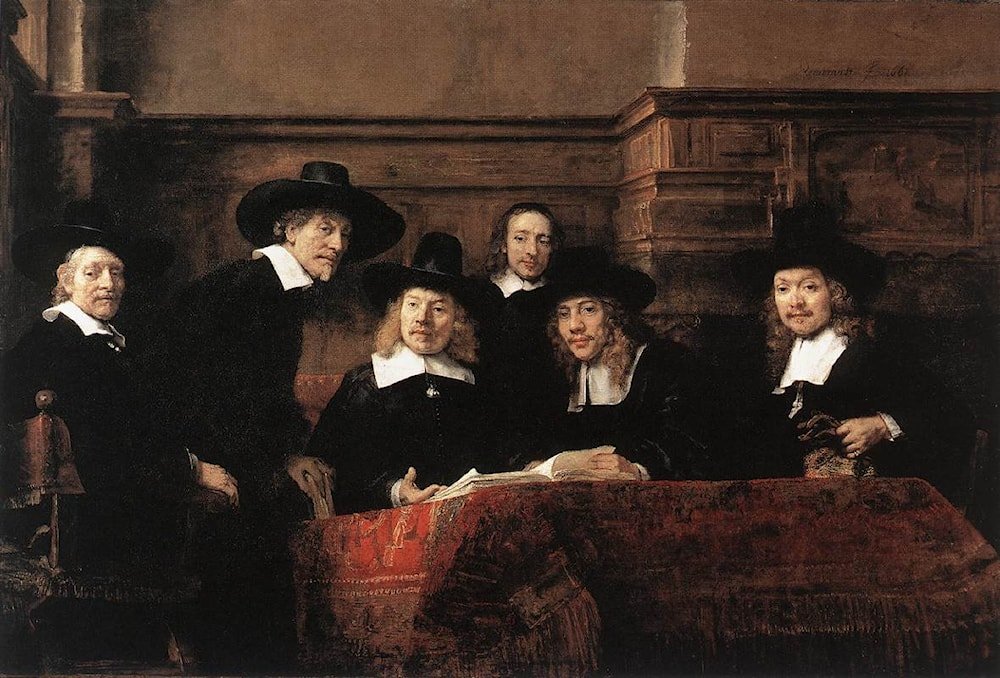
Rembrandt | Sampling Officials of the Drapers’ Guild | 1662
One way of trying to understand and appreciate works of art is by means of formal analysis, that is by looking at them not in terms of subject matter or technique, but in terms of purely formal concepts.
Through a careful study of Renaissance (late 15th- and early 16th-century) and Baroque (17th-century) works of art, Wölfflin distilled a number of principles, which he arranged in five pairs, which helped him characterize the differences between the styles of the two periods.
http://arthistoryresources.net/baroque-art-theory-2014/wolfflin-renaissance-baroque.html#Top
- Painterly v/s Linear
The painting is painterly. The three center figures are fused together triangularly in a see-saw composition. Contours are lost in shadow, swift brush-strokes bind separate parts together rather than isolating them from one another. - Planar v/s Recessional
The painting is planar, meaning that the elements of the painting are arranged on a series of planes parallel to the picture plane. - Open Form v/s Closed Form The painting is in open form. Checkerboarding is present to create movement. There is a feeling of space beyond the edges of the picture.
- Unity v/s Multiplicity.
The painting has Unity. All the units are welded into a single whole. Colors of the robes and dark shadows blend and mingle, and their appearance depends largely on how the light strikes them. - Relative Clarity v/s Absolute Clarity.
The painting has relative clarity, representing things as they look, seen as a whole.
Although no man has seen God since the fall, may Rembrandt’s oil painting, Sampling Officials of the Drapers’ Guild, be made as clear to you as though you had seen a picture of God’s house in heaven, the Most Holy Place. God is no longer at arm’s length or a thousand miles away, but we’re in the same room with him in the Most Holy Place.
Although there are many symbols in this painting, let’s focus on the one center man standing.
Christ, the slaughtered Lamb, stands. A strange contradiction.
Christ, The High Priest, always ministered the blood, and could never enter the Most Holy Place without fresh blood.
The Priest and the sacrifice always commingled.
As John the Revelator sees him, he’s still dying on Calvary, although he’s still living in heaven. The Lamb in the act of being offered. Christ continually dies to sin.
There’s nothing like heaven.
As the mystery of redemption unfolds in my mind, I marvel at God’s grace. I’ve landed on an idea that’s so dreamy that even reality is hard to understand. This is the sanctuary service.
 §tacyReneè§weeney